
The Promise: $100 Billion in 90 Days
When the Department of Government Efficiency burst onto the scene in early 2025, the messaging was crystal clear. Led by Elon Musk in an advisory capacity, DOGE claimed to identify over $100 billion in potential federal savings within its first three months. That’s the kind of number that gets headlines. That’s the kind of number that makes people sit up and ask: could this actually work?

Here’s the thing about big promises in government. They’re easy to make when you’re counting theoretical savings rather than actual dollars returned to the Treasury. DOGE’s methodology involved identifying programs with overlapping functions, consulting contracts they deemed wasteful, and administrative redundancies scattered across the federal bureaucracy. On paper, it looked comprehensive. The real question was always going to be: what sticks?
The Reality Check: Courts, Methodology, and Actual Numbers
About six months in, the gap between DOGE’s claims and reality started showing some serious cracks. Multiple federal courts issued injunctions restricting DOGE’s access to Treasury Department payment systems and Social Security Administration data. The legal reasoning centered on a straightforward question: did DOGE actually have the statutory authority to access and manipulate these systems the way it wanted to?
Meanwhile, the Congressional Budget Office did what it does best. It looked at DOGE’s numbers and asked hard questions about methodology. What emerged was a split-screen picture. DOGE was claiming massive savings. The CBO was projecting that actual realized savings would be significantly lower. The dispute wasn’t just about arithmetic. It was about how you define a “saving” in the first place. Is it an identified opportunity? A programmed reduction? Money that actually stays in the Treasury instead of being spent? These aren’t abstract questions. They matter enormously for understanding whether this whole initiative is delivering what it promised. Check out the Congressional Budget Office Federal Workforce Analysis if you want to dig deeper into how these projections were built.
The Human Cost: 75,000 Federal Workers and What We Lost
Now here’s where it gets serious. By March 2025, roughly 75,000 federal employees had accepted deferred resignation offers under DOGE-facilitated buyout programs. That’s not a small number. That’s an entire small city’s worth of people leaving government service, often with 30 or 60 days notice.
Agency inspectors general started raising red flags almost immediately. Institutional knowledge doesn’t come back easily. When a benefits administrator with 15 years of experience takes a buyout, what walks out the door with them? The processes they’ve learned. The problems they’ve solved before. The informal networks that actually keep complex systems running. You can hire new people, sure. But there’s a ramp-up period. Mistakes get made during transitions. Services get slower or less reliable.
This is the part of the efficiency calculation that’s hardest to measure but maybe most important to understand. Yes, you save payroll dollars. But what’s the cost to service delivery? What’s the cost to Americans who depend on timely passport processing, Social Security eligibility reviews, or Veterans Affairs claim decisions? That’s not an argument against ever reducing federal employment. It’s an argument that honest accounting has to count both sides of the ledger.
Leadership Transitions and What Remains
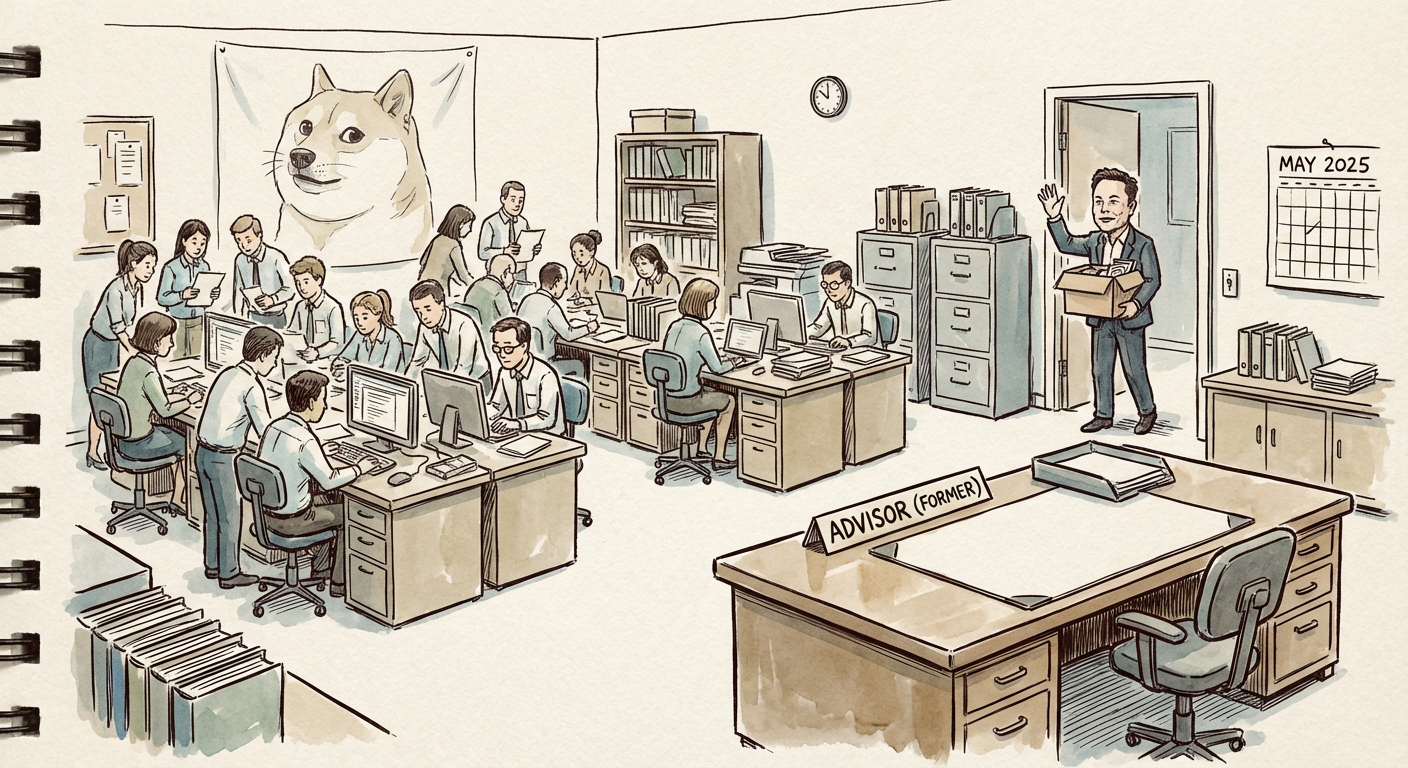
By May 2025, Elon Musk stepped back from his formal advisory role at DOGE. That raised its own set of questions. Had he accomplished what he set out to do? Was he moving on to other projects? The official story was that the office would continue operating under administration direction. The practical story was a bit more modest: DOGE was now running with fewer than 50 people instead of the larger advisory apparatus assembled in the early months.
Despite the personnel reduction and leadership change, DOGE didn’t disappear. The office kept functioning. That tells us something. Whatever debate surrounds specific initiatives or claimed savings, the appetite for government efficiency work persists across the administration. The question for citizens, though, is whether that work is happening with the transparency and accountability that democracy requires.
The Accountability Question: Where Do We Stand?
This is the through-line for evaluating DOGE’s first year. Claimed savings versus realized savings is important. Payroll reductions versus service quality is important. But underlying both is a fundamental democratic question: how much visibility do citizens have into what’s happening?
The court injunctions matter not because they necessarily stopped important work, but because they reflect a collision between executive action and statutory safeguards. Those safeguards exist for reasons. They make sure that when government changes how it operates, it does so with appropriate checks and balances. When courts are issuing injunctions against access to payment systems, that’s a signal that the normal democratic guardrails are engaging. That’s not always pretty. It’s not always efficient. But it’s usually necessary.
For a more systematic dive into what happened, the Brookings Institution DOGE Accountability Review offers detailed analysis of how the initiative unfolded and what it means for government reform going forward.
What We Actually Learned
After one year, here’s what’s clear. Government does have waste. Finding it isn’t magic. It requires serious analysis, good data, and people willing to ask hard questions. DOGE did some of that. Whether it did so responsibly, transparently, and with appropriate oversight is where reasonable people disagree.
The $100 billion in identified savings probably included some real opportunities. The CBO’s lower projections for realized savings probably reflect both accounting differences and genuine implementation challenges. The 75,000 federal workers who left took real expertise with them. And the courts’ willingness to restrict DOGE’s data access signals that democratic institutions are still functioning, even if imperfectly.
The bigger lesson? Government reform is hard. Cutting costs and maintaining service quality aren’t always the same thing, and anyone telling you otherwise is selling something. Real reform requires balancing efficiency with accountability, and it requires citizens who understand enough of this complexity to ask smart questions of their elected representatives.
What’s your take on how DOGE’s first year played out? Have you tracked specific efficiency initiatives in your own region or sector? The conversation about how government should work is everyone’s responsibility. I’d genuinely like to know what you’re seeing in your community.