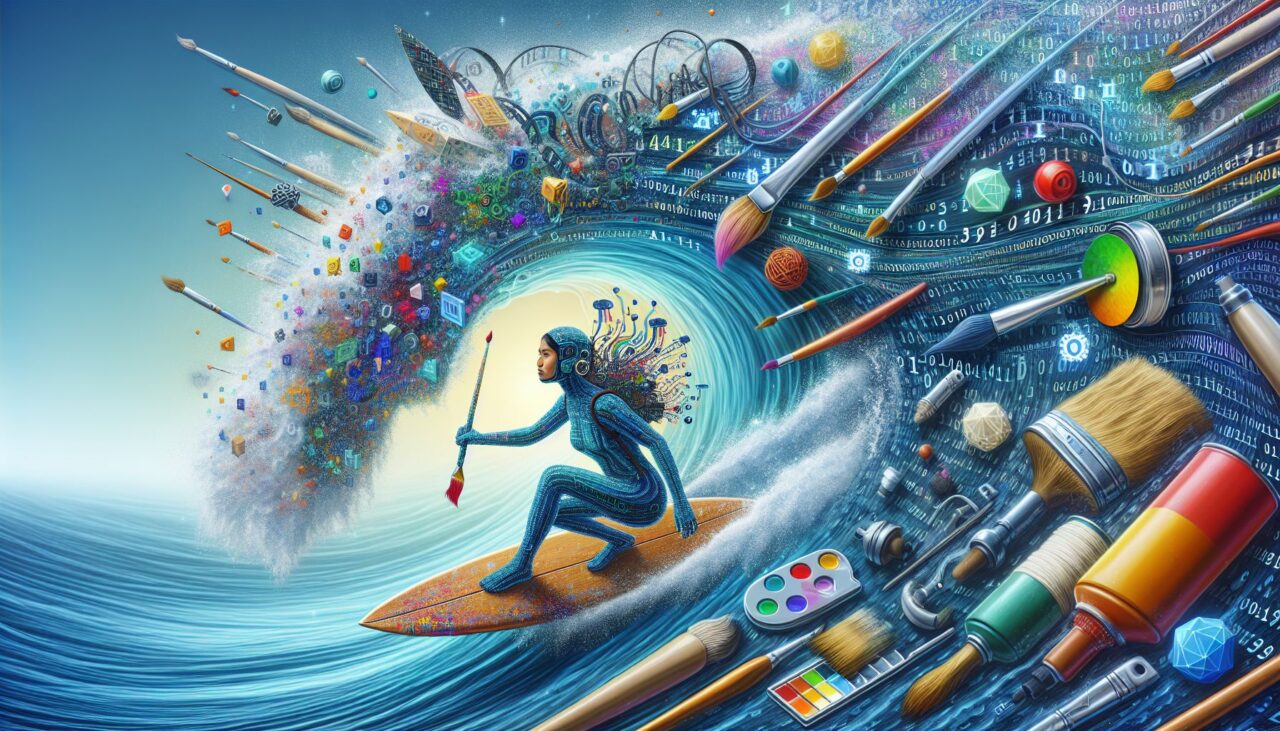
Hey tech enthusiasts! Today, we’re diving deep into the mesmerizing world of Artificial Intelligence in creative arts. Let’s face it—AI is doing some pretty jaw-dropping stuff these days, but when it comes to art, it’s like handing a futuristic paintbrush to Picasso meets Tesla, the car—not the person. So, grab that cyber-coffee (if that’s a thing) and let’s explore how AI is reshaping the creative frontier, one pixel at a time.
From Code to Canvas: The Birth of AI Art
Remember when computers were just those big clunky machines chugging along to help with math problems? Well, it turns out they’ve picked up a few more tricks since then. AI in art is honestly kind of wild when you think about it. Technology and creativity are mixing together in ways nobody really expected.
A Brief Trip Down Memory Lane
First, let’s take a quick trip down AI Art memory lane. Back in the day (and by “day,” I mean a couple of decades ago), computers could barely string together a coherent sentence. Fast forward, and now we have algorithms like DALL-E, from OpenAI, generating visuals at the drop of a hat, or more accurately, at the drop of a prompt.
It all began with early neural networks trying to mimic human artwork. Think a robot wielding a paintbrush at a toddler level. Of course, just like humans, AI programs got better with practice. Fast forward to today, and these algorithms no longer just copy human art. They create their own weird, distinct, often surreal works. And the best part? Artists worldwide are using these tools to help with their creative process. Who would’ve thought your next favorite artist might actually be a machine?
The New Tools of The Trade
So, how does this magical blend of technology and art actually happen? Let’s take a peek under the algorithmic hood to see some tools that are fundamentally changing how creative arts work.
GANs: The Power Behind The Paintbrush
Generative Adversarial Networks, or GANs for the insiders, have become a major driving force behind AI-generated art. These clever little algorithms pit two neural networks against each other, a kind of creative rivalry, to generate some truly impressive pieces. Picture a scenario where two AI bots are hell-bent on one-upping each other on canvas. The result? Art that can have even the dullest party staring at its pixels, mouths agape.
The Influence of NLP
Natural Language Processing isn’t just for chatbots anymore. No, sir! Artists use NLP tools to create complex storylines or even poetic verses that accompany the visuals. Imagine explaining to an algorithm what you want, a landscape that speaks of wanderlust and mysterious islands, and having it draft a visual and narrative that could rival the opening scene of the next blockbuster movie.
Accessibility for All
What’s particularly thrilling is how accessible these tools have become. Platforms like DeepArt or RunwayML allow everyday creators without a Ph.D. in Computer Science to explore their creativity using AI. It’s almost like we’ve all been given a VIP pass to the future of art, and trust me, the possibilities are mind-blowing.
The Big Picture: Opportunities and Challenges
Alright, while the notion of robot Picassos might sound all glow and glory, let’s keep it real. This AI artistry wave brings its own set of opportunities and challenges.
A New Era for Artists
In what could be considered a techno-utopian twist, artists now have access to tools that were once tucked away in the back-rooms of high-tech labs. This offers a unique opportunity for collaboration between humans and machines. Imagine an artist and AI co-creating, each bringing a unique set of tools, perceptions, and creativity to the table.
These tools can help streamline workflows and offer new, innovative ways to express ideas. Need an instant brainstorm partner? How about that AI algorithm that can generate hundreds of visual variations in seconds? Talk about hitting the creative jackpot!
Navigating the Ethical Maze
But let’s address the elephant, or rather, the algorithm, in the room. With the rise of AI-generated art, copyright and plagiarism concerns abound. Who owns a piece of art the moment AI finishes it? Is it the programmer behind the code, the artist who prompts it, or the AI entity itself? This is a question that currently resides in a grey area murkier than a foggy day in Silicon Valley.
There’s also the worry about diminishing the value of human artistry. If an AI can whip out a masterpiece in the time it takes us to grab a cup of coffee, are we commoditizing creativity? It’s a philosophical conundrum that is both mind-bending and exciting.
Sparking A Dialogue
These challenges aside, one thing’s for sure: AI is sparking conversations across artistic communities globally. Whether it’s the traditional artists skeptical of tech encroaching on their space or digital artists celebrating new mediums, dialogue is key. After all, change is the only constant, and it’s when we swap stories and share diverse perspectives that real evolution occurs.
A Glimpse Into The Future
So, what lies ahead for AI in the creative arts space? If I had a crystal ball, or maybe just a really advanced AI, I’d say the future is promising, albeit unpredictable. With advancements in both AI and artistic methodologies, it’s only a matter of time before we witness something so revolutionary that it’ll redefine art as we know it.
Speculating on New Horizons
Imagine an interactive installation where AI responds to your emotional cues and adjusts the art in real-time. Or perhaps AI-designed fashion that predicts trends before humans even come close. We’re venturing into an era where our wildest creative dreams could very well become our lived realities.
Wrapping it Up
As we stand here on the brink of this artistic evolution, it’s impossible not to feel a surge of excitement about where we’re headed. AI isn’t just a tool, it’s a partner in creativity’s future. It’s waving its digital wand, ready to shape a canvas where creativity isn’t limited by skill but is potential for anyone who dares to dream.
What do you think about AI’s foray into the creative world? Are you imagining an algorithmide with your favorite creative tool? Or does the idea make your art purist heart skip a beat (in the wrong way)? Let’s keep the conversation going, because the future of creativity is here, and it’s digital, dynamic, and darn exciting.